One Need Not be a House
by RadiatorYang
AKA: Its 7pm on a Sunday night, I think a Quake map is making me cry and I don't know why.
This map fills me with an overwhelming sense of grief and loss.
Part of it may be that there are so many empty chairs on ONNBAH, Robert Yang's Riven-esue contribution to QBJ3. I haven't counted them all, but they litter the island you explore over the course of the map. Some are arranged with purpose - a gathering around a table or placed with an eye to just sitting and admiring the view, some are more haphazardly scattered. Some are in pairs, some are alone. Some feel they have some obvious purpose, some seem haphazardly placed. One sits partly buried in the gravely sand of the beach, another sits unreachable atop a staircaseless tower, an unsolvable mystery now and forever. All are empty, and while this island is still inhabited, nobody will ever sit in any of them again. This is a graveyard to a time and people long gone.
There are people on the island, but these are not their chairs, of that I am sure. Fascists like these have no need for them. A chair implies rest, vulnerability. These people discarded those long ago and are capable of nothing but violence. The chairs are not theirs, nor are the structures on this tiny island. Its form is too delicate and well considered for that. It doesn't intimidate with its scope, attempt to make its occupants feel small; it has no obvious purpose. There are hints of industrialism at its heart, empty giant pipes and silos left to rust. Perhaps it was meant to cleanse the acidic ocean surrounding the island, perhaps it caused it. Maybe it has something to do with the pile of Cthon corpses bured at the bottom of one of the silos. I don't really know and to speculate misses the point: that this space is purposeless and inscrutable. Whatever it once was is lost with nobody to remember it.
As much as the monsters don't belong here, nor do I really. The Quake ranger (or Rover as she is in QBJ3) is mortally opposed to the fascists, but still knows only how to kill; stuck in an undending stream of corridors and masked fascists and bullet ridden dystopias; trapped in the limits of a video game from 1996.
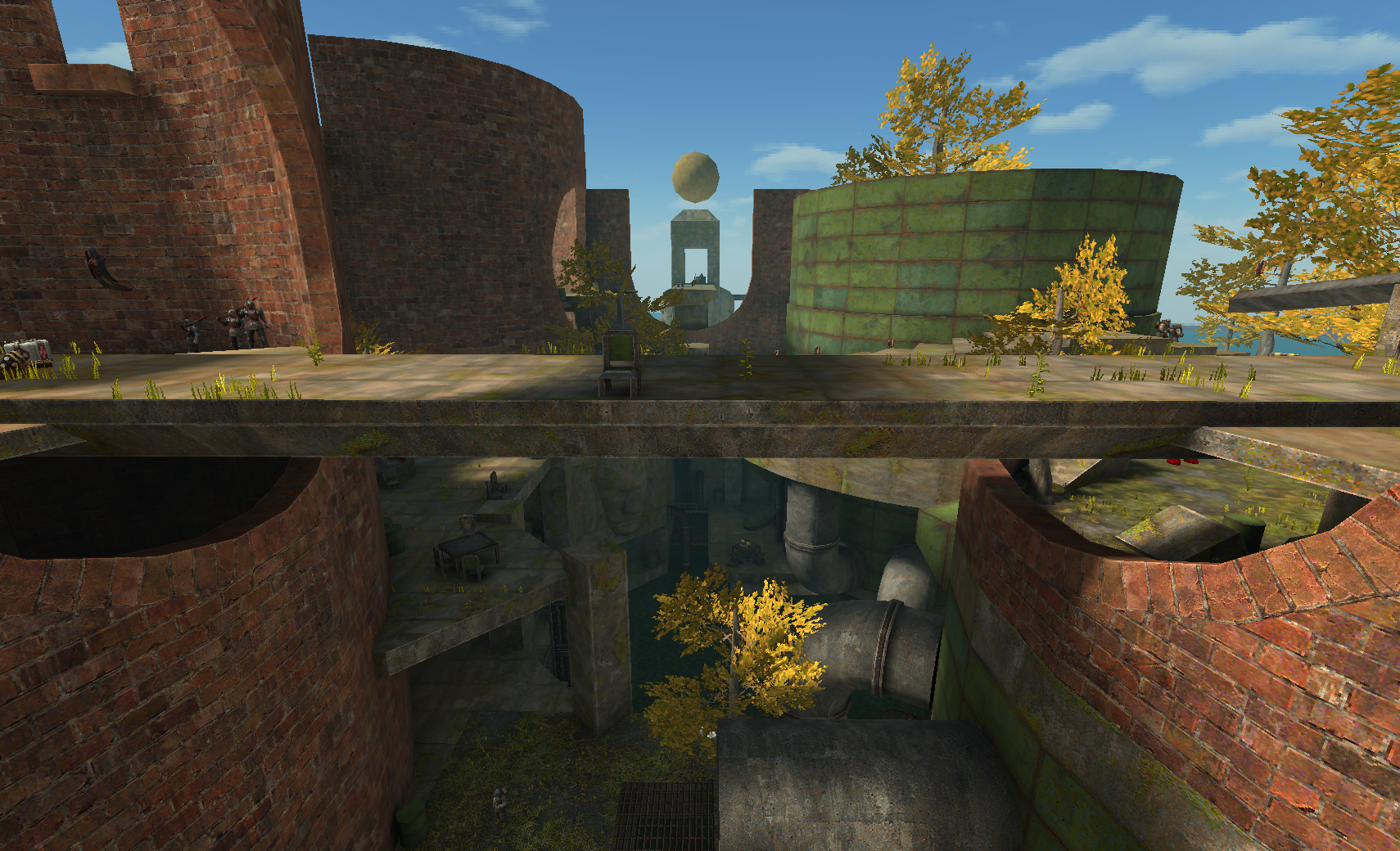
Can she imagine stopping, sitting, taking in the atmosphere? Can I? This iteration of Quake is one of longing and desire. My control over the player avatar allows me to force them to stop and look, but never touch; dream, but never attain.
This map is also unusual in its non linearity. User maps, at least in the current moment, tend towards highly scripted and choreographed sequences. They use keys and buttons to carefully guide their players through the level in an intentional order. This bucks that trend. The island is roughly divided into three tiers. Starting at the beach on the base of the island, your only implied goal is to ascend and explore the map, which you can do in a few of different ways. Take a left can you can immediately dive into the industrial heart of the island and find your way up, at the expense of some weapons and armour on the other routes. Take a right and you'll gradually pick your way around the edge of the toxic sea, with several more oppurtunities to access the second tier and pick up weapons as you explore.
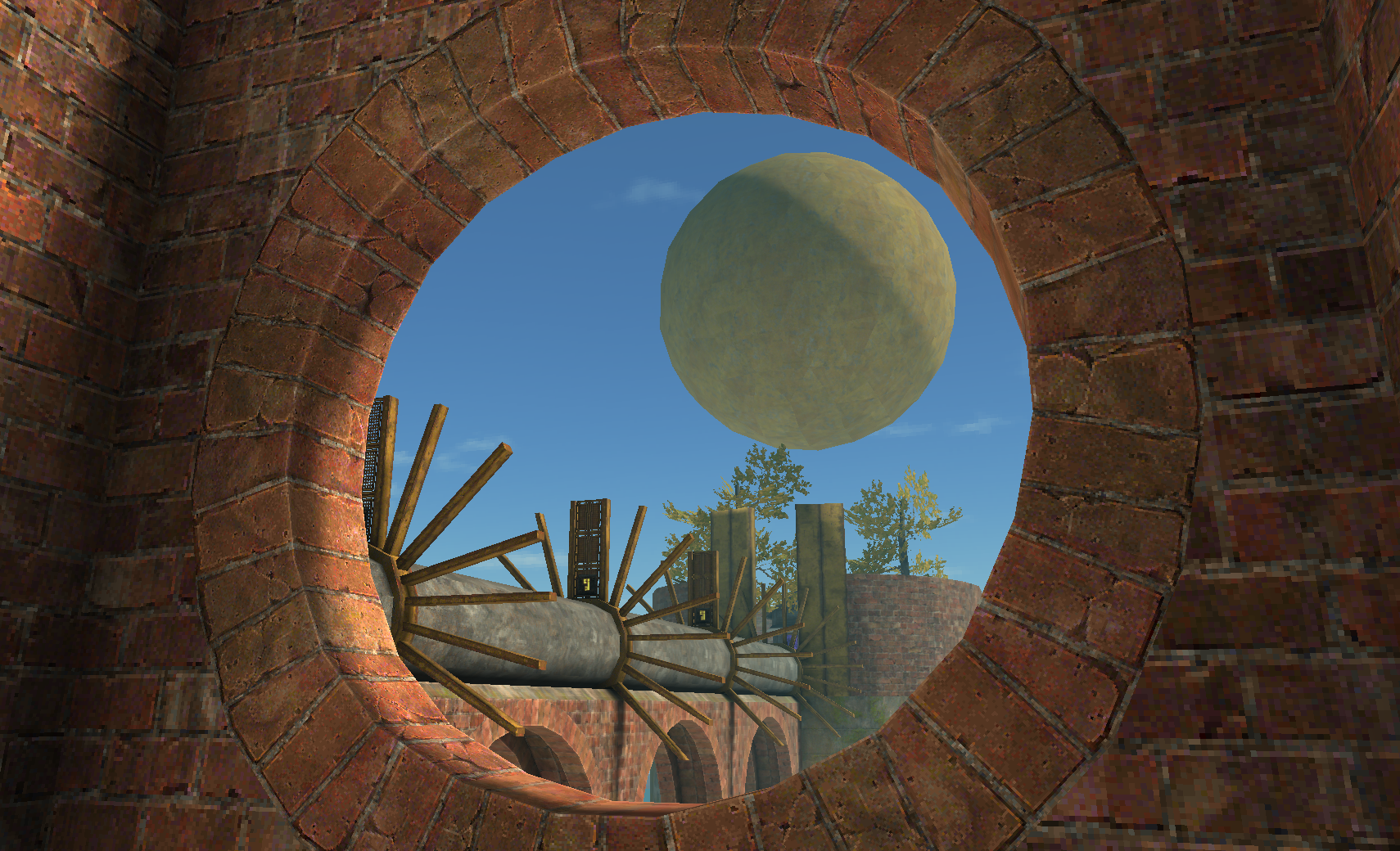
From the second tier, you need one of the several silver keys scattered around to open one of the pathways to the third tier, at which point the larger goal of the map reveals itself. Thorough exploration will get you enough gold keys to cross the aqueduct to the end of the map. This loose map structure, where you may end up coming at enemies from pretty much any direction or may or may not have any of the powerups or weapons, makes for a very relaxed and freeform time. Its not that its an easy map or shoddily thought through, there are plenty of enemies, and enought terrain and variety to keep you on your toes the whole time. But in some way it loosens expectations. If convential map design puts you in the room and asks you to conform to the challenge of that room, this map just sort of shrugs and lets you figure it out. Go a different direction to find a more powerful weapon or powerup. Ignore that area entirely. Approach it from a different side. Whatever, its all good. Its this sense of slight apathy that I'm getting at. Again it is not that the map is slipshod or careless, it just... is. Whatever you want or expect from it, it folds its arms and quietly waits regardless.
The soundscape is a big player in all this too. Apart from the ambience of waves hitting the shoreline, the background track is... something. Its this gentle humming that starts to build up, complimented every now and then the same three note sequence. After a couple of minutes it comes to this hurtling crescendo of the same notes before cutting out, leaving you with just the ambience of the water and your own thoughts.
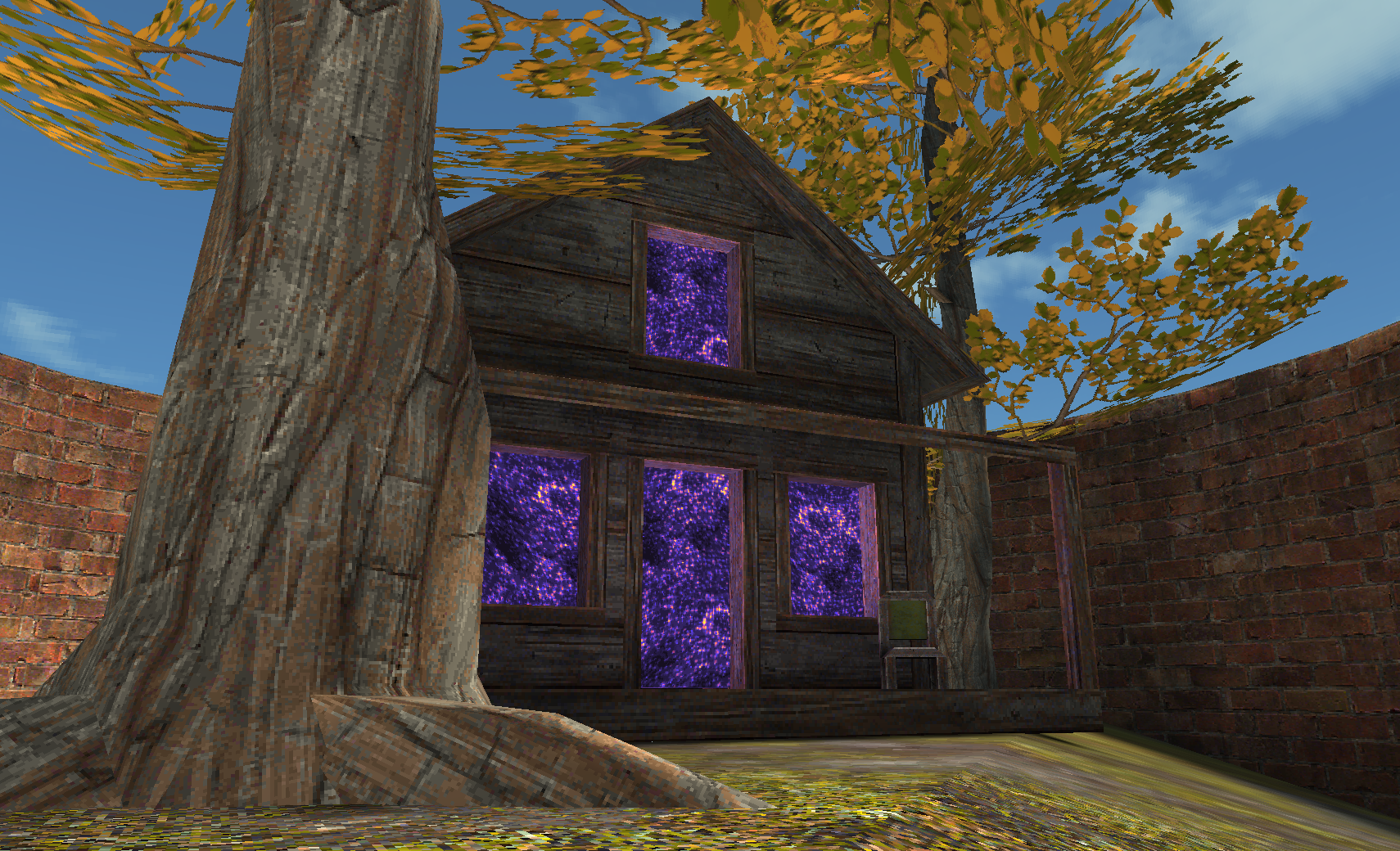
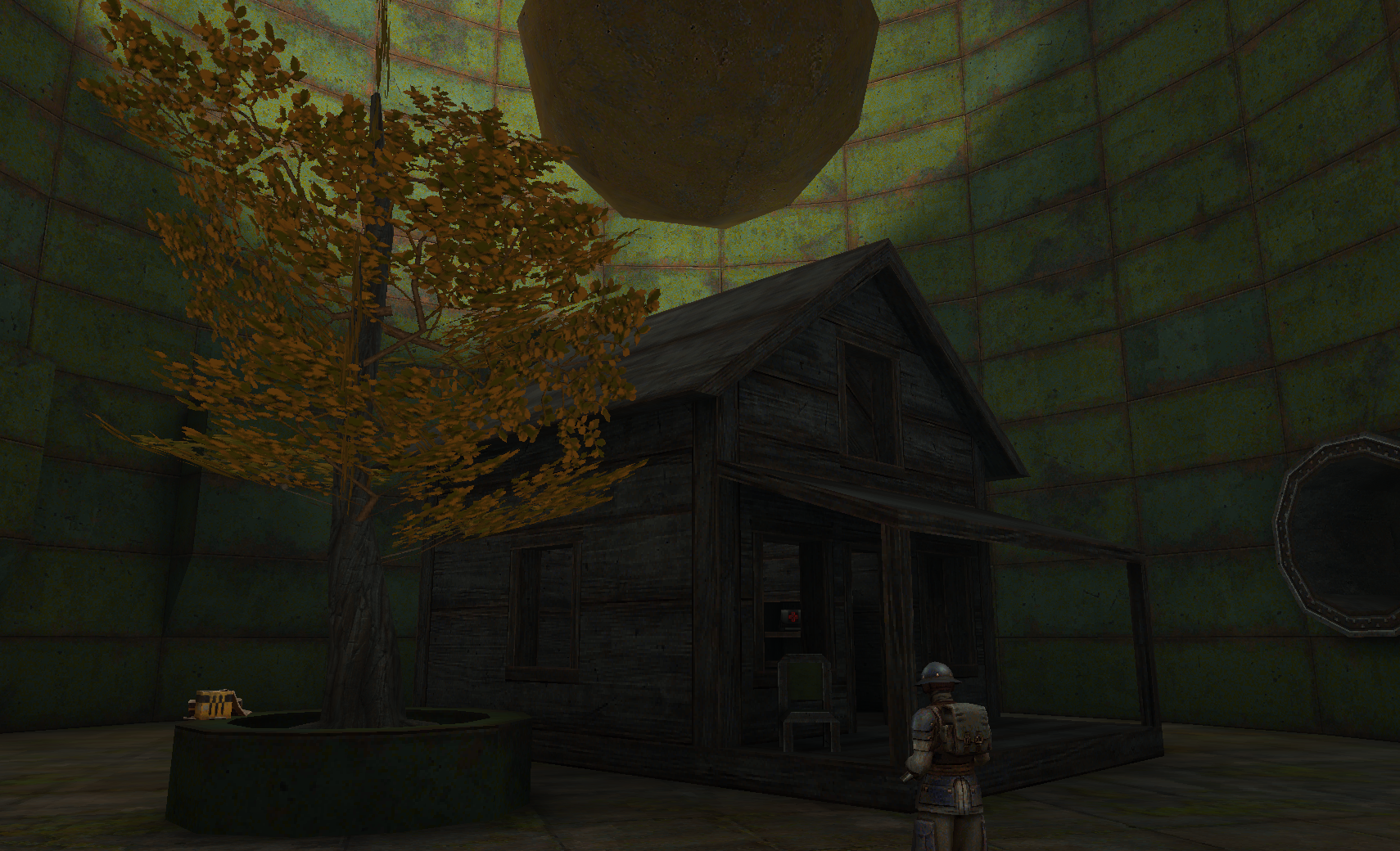
The end goal itself is a simple wooden house. Actually there are twinned wooden houses. I mentioned earlier the pile of Cthon corpses in one of the industrial silos. One house is the goal of the map, the other is buried deep in the other silo. Its an uncanny effect when you first encounter it, so obviously incongruous in its plain style and material. How did it get here? Is it the remnants of an older world, paved over by this newer layer of architecture? Was it dissasembled and carefuly reassemlbed here for some unknown reason unknown purpose? Yang's answer of course rightly rejects any literal interpretation, seeing it as a representation of the pre-modern paved over by the modern; a haunting spectre that the modernist style is inherently a reaction to but can never escape. Which is fine enough, but a little too tidy for me.
"Don't you know you can't go home again?" So apparently spoke Ella Winter, inspiring the title of Thomas Wolfe's 1940 novel. The world is constantly changing and we are changed in turn as we pass through it. Odysseus cannot return home unscathed from the war, instead he brings home the violence of that war to his household, butchering would be suitors and """treacherous""" maids alike. The war of the ring brings the cruelty and violence of industrialism to the shire in a way that can never be erased from their formerly idyllic and sheltered society. George Webber finds himself alienated by the rapidly changing world; rampant capitalism, stock market crashes, the rise of fascism, persecution of minorities, the rejections dealt by the people and places he grew up in.
Over the course of most of my adult life some variation of this theme has been ringing in my ears, growing louder and louder as the years pass me by until it has become near deafening. We entered a 'once in a generation' financial crisis in my early teens. Nearly two decades later, it feels like we never really emerged and that the last 20 years of politics has been about desperately trying to stuff the toothpaste back in its tube in increasingly violent and hostile ways. If we just throw a few more minorities into the grinder, you can be important again. Your children will talk to you at family events again. You'll be respected for your intrinsic status and not for your words or actions. You can never go home again.
"If you go home, don't come back." For the most part this map trusts the player to navigate it without overt guidance on how to interpret or experience it. This is the sole piece of text, given as the player steps towards the exit portal, itself contained within the upper house of the level.
For the flaws it had and has, brutalism looked forward. It imagined a future and sought to manifest its ideology in the fabric of the buildings it built. Architecture must exist as a response to or an affirmation of the present. Each movement must have its own pathetic wooden house lurking in its depths. So also must we all have our own house buried within us. A continual process of reactive construction but one that we can take control of if we wish. It feels important to me not to forget that, personally and politically. Writes Yang on his own inspirations: While Kahn isn't the first architect you'd associate with brutalism, his unadorned brick monoliths are very brutalist, showcasing the raw material and brick's unique affordance for archways. It also embodies a critique of orthodox Western brutalism's concrete fetish -- a truly global brutalism must adapt to diverse climates, materials, and cultures.
If you go home, don't come back. Sounds about right.
If it isn't clear. I adore this map. It speaks to me in a way I struggle to put into words and I hope I've been able to convey a little of that. There is much more I could ramble about but should probably stop here.
You also can read Rob's breakdown of his process here.